
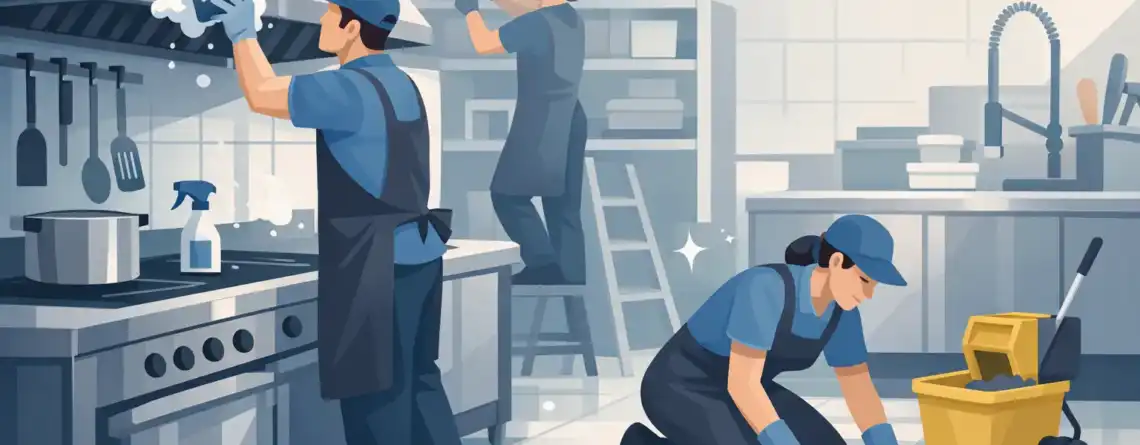
One failed inspection, one grease flare-up, or one pest sighting during service can cost far more than a routine clean. That is why restaurant kitchen deep cleaning is not a cosmetic extra. It is a practical part of running a safe, efficient, and professional food business.
A busy kitchen can look clean at the end of the shift and still hide serious buildup. Grease settles behind fryers, under prep stations, inside vents, and along wall edges. Food particles collect in hard-to-reach corners. Moisture around drains and dishwashing areas creates the kind of environment where bacteria and pests can thrive. Daily wiping helps, but it does not reach the places that cause the biggest problems over time.
Why restaurant kitchen deep cleaning matters
In a commercial kitchen, speed is everything. Staff are focused on prep, service, and closing tasks. That usually means surface cleaning gets done, while hidden buildup keeps growing in areas that are awkward, hot, or difficult to access during operating hours.
This is where deep cleaning makes a clear difference. It reduces grease accumulation that can increase fire risk. It supports better hygiene in food preparation areas. It helps equipment perform more efficiently because vents, filters, and surrounding surfaces are not clogged with residue. It also protects your reputation. Customers never see under your line equipment, but hygiene issues in those areas often show up elsewhere through odors, pests, smoke, or poor inspection results.
For restaurant owners and managers, the real value is prevention. Deep cleaning is usually less expensive than emergency repairs, pest treatment after an infestation, or downtime caused by a failed hygiene standard.
What a deep clean should actually cover
Not every cleaning service handles commercial kitchens properly. A true deep clean goes beyond mopping floors and wiping stainless steel fronts. It targets the buildup that daily teams cannot fully remove within a standard shift.
Cooking line and equipment surroundings
The highest-risk areas are usually around cooking equipment. Fryers, grills, ovens, salamanders, and hot holding units collect layers of grease that spread to nearby walls, floors, and utility connections. A proper deep clean should address the fronts, sides, backs, undersides, and the floor beneath movable equipment wherever access is possible.
This matters because grease does not stay in one place. Air movement and heat distribute it across surfaces, where it traps dust and food particles and becomes harder to remove over time.
Extraction and ventilation areas
Kitchen exhaust systems deal with heavy grease and heat every day. While the full duct system may require specialized hood and duct work depending on setup, surrounding extraction surfaces, accessible filters, and nearby ceiling areas should not be ignored. When grease accumulates here, hygiene and fire safety both become concerns.
The right approach depends on your kitchen layout and volume of cooking. A small cafe with limited frying needs a different schedule than a high-output restaurant running long hours.
Floors, drains, and hard-to-reach corners
Many hygiene issues begin at floor level. Greasy residue spreads under equipment wheels, along skirting, and into corners that standard mopping misses. Drains also need attention because food waste and moisture combine quickly in these zones.
If these areas are left untreated, they can produce odors and attract pests even when visible counters look spotless. For restaurants, that turns cleaning into more than a presentation issue. It becomes an operational risk.
Food prep and storage zones
Prep counters, shelving, cold room exteriors, door handles, tiles, and splash areas all need detailed cleaning. In storage areas, dust, residue, and spilled dry goods can quietly build up and affect hygiene standards.
A good service checks the transition points too – the places between prep, wash, and storage where contamination is most likely to spread through touch and movement.
Signs your kitchen needs deep cleaning now
Some kitchens follow a fixed schedule, while others wait until there is an obvious problem. The second approach usually costs more. If your staff notice sticky floors soon after mopping, lingering cooking odors, greasy wall film, or stains returning quickly, buildup is already beyond normal daily control.
You should also act fast if equipment areas are hard to inspect because of residue, if drains smell unpleasant, or if pest activity appears near food or waste zones. In restaurants, pests rarely show up without a reason. Grease, crumbs, moisture, and neglected corners create the conditions they need.
If you are preparing for a health inspection, reopening after maintenance, changing menu volume, or taking over a new restaurant unit, deep cleaning should be part of your plan before service begins.
How often restaurant kitchen deep cleaning should be scheduled
There is no single rule that fits every operation. Frequency depends on how much grease your kitchen produces, how many hours you operate, what equipment you use, and how consistent your closing routines are.
A quick-service kitchen with heavy frying may need professional deep cleaning much more often than a small concept focused on cold prep and light cooking. Restaurants with extended hours also face a challenge because residue builds faster when equipment rarely has time to cool and cleaning windows are tight.
For most operators, the sensible approach is to combine strong daily cleaning with scheduled professional deep cleaning at regular intervals. If your kitchen has already fallen behind, one intensive service may restore standards, but keeping the result usually requires a recurring plan.
Why professional cleaning works better than internal catch-up sessions
Many restaurants ask their own team to do occasional intensive cleaning. That can help with upkeep, but it has limits. Kitchen staff are trained for food service first. They are often short on time, working around fatigue, and unlikely to dismantle access points or reach difficult zones thoroughly after a full shift.
Professional teams work with a different process. They come prepared with the right degreasers, tools, protective methods, and task sequence. More importantly, they clean with inspection in mind. That means focusing on the hidden points where hygiene failures, grease hazards, and pest issues usually start.
This is also where safety matters. Commercial kitchens need products and methods that are effective without creating unnecessary risk around food-contact environments. A dependable provider uses appropriate cleaning agents, trained staff, and a clear scope of work so nothing critical is missed.
Restaurant kitchen deep cleaning and pest prevention
Cleaning and pest control are closely connected in food businesses. You can treat pests, but if grease, food debris, and moisture remain, the source problem is still there. Deep cleaning reduces the conditions that attract cockroaches, ants, flies, and rodents in the first place.
That does not mean cleaning alone solves every infestation. If activity is already established, pest control may also be necessary. But in many restaurant environments, sanitation is the foundation. Without it, pest treatment becomes a short-term fix instead of a lasting solution.
For operators in high-density commercial areas, this matters even more because neighboring units, shared waste zones, and delivery traffic can increase exposure. In Doha, where restaurants often operate in fast-paced mixed-use settings, keeping kitchens deeply cleaned on schedule helps reduce both hygiene and pest pressure.
What to look for in a service provider
Choose a company that understands commercial kitchens, not just general cleaning. The team should be able to explain what areas are included, what products are used, how they handle grease-heavy surfaces, and whether scheduling can be done around your operating hours.
Reliability is just as important as cleaning quality. You need a provider that arrives on time, works efficiently, and respects food business requirements. If disinfection or pest control support is also needed, having one trusted service partner can make ongoing hygiene management much easier. That is one reason many restaurant operators prefer working with experienced companies such as Hegy International for practical, scheduled support.
Price matters, but the cheapest option is rarely the best value if corners are skipped. A proper deep clean should leave your kitchen visibly cleaner, easier to maintain, and safer for your team to work in every day.
The best time to book a deep clean
The best time is usually before there is a visible problem. Plan around quieter trading periods, pre-inspection windows, menu expansions, or seasonal increases in volume. If your staff are constantly fighting the same grease and odor issues, that is already your signal.
A clean kitchen supports faster daily cleaning, better staff morale, and more confidence during inspections. It also protects the standard your customers expect, even if they never step behind the kitchen door.
When a restaurant kitchen is truly clean, the difference shows up everywhere else – in safety, consistency, and peace of mind.